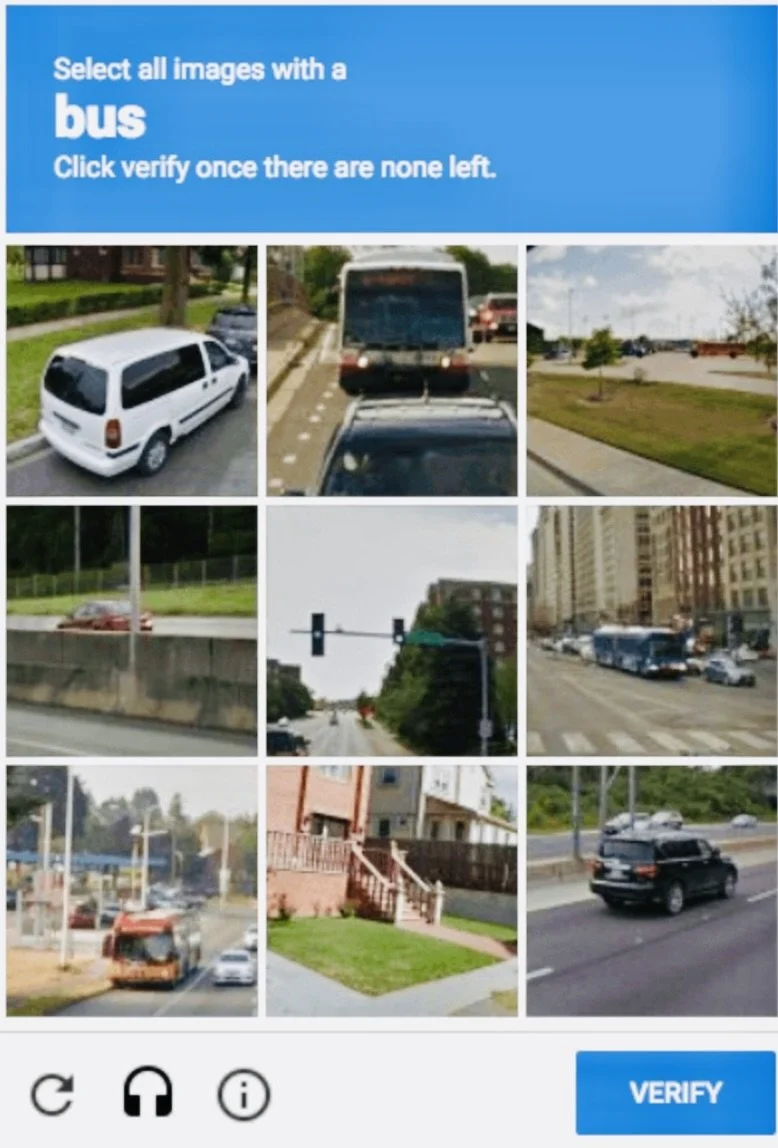
We’ve all been there. Perhaps you’re filling out an online form or need to proceed to a page of interest, but before you can gain access you’re required to prove yourself to be a real live person. Presented with nine squares featuring out of focus images, you are asked to identify palm trees, motorcycles, crosswalks, hydrants, buses, traffic lights and more. Isn’t that what we all want to do when we’re trying to get something done?
Yet there you sit in the land of CAPTCHA, hoping to get it right on the first try. No one wants to go down that annoying rabbit hole that demands superior eyesight and attention to detail, over and over again. All we want to do is get to the next step and find what we’re looking for instead of finding palm trees and hydrants and buses that don’t even look like buses.
CAPTCHA, an acronym for "Completely Automated Public Turing Test to Tell Humans Apart," has been around since the late 1990s. Developed in response to internet hackers who use bots to make life difficult and costly, CAPTCHA interrupts our focus and uses a lot of our time. It takes an average user 32 seconds to complete and with 4.6 billion global Internet users, wastes 500 human years every day.
The National Inventors Hall of Fame credits computer scientist Luis von Ahn with co-inventing CAPTCHA and reCAPTCHA. Von Ann was part of a Carnegie Mellon University team that worked with Yahoo! to improve security and in 2018, received the $500K Lemelson-MIT Prize for his groundbreaking inventions in global computer technology.
Clearly, having reliable authentication that can identify bots is a good idea. But why is it still so cumbersome to use?
A recent LinkedIn article cites improved optical character recognition, machine learning advancements and generative adversarial networks as some of the reasons CAPTCHAs have become increasingly challenging. There’s hope ahead for a less disruptive experience while proving you’re not a bot, but in the meantime we’ll have to stick it out.
For me, the bothersome CAPTCHA is a good reminder to keep content easy to access and consistently relevant. Here’s to launching 2024 with clear communications in our blogs, websites, newsletters, annual reports, and any other communications we produce. In our loud, overcrowded, cumbersome world of information, you deserve to be noticed and appreciated.
